A personal page for students
A student with no full-time experience still has plenty to show: projects, coursework, competitions, clubs and part-time work. A simple page gathers it in one place for internship applications, scholarships and the occasional freelance gig.
What your page should include
- What you study, where, and when you graduate
- Two to four projects with what you built or found
- Competitions, hackathons, research or club leadership
- Skills you can prove, linked to the proof
- A resume download and a way to contact you
Sections that work
About me → Projects → Achievements → Skills → Resume & contact
Looks to start from
Paper or Bento Candy: clean with a little personality. Ivo can restyle any of them to your colours.
Why a page helps before your first job
Internship recruiters, scholarship committees and professors reading research applications all face the same problem: every student's resume looks alike. A one-page resume can't fit the robot you built, the dataset you cleaned, the society you ran or the article you wrote for the college magazine. A personal page can, and it's the link you add to your resume, LinkedIn and email signature.
It also helps the other way. A senior or alumnus who meets you at a fest or a hackathon can look you up later and find something better than a blank LinkedIn.
What counts as experience
More than you think. Any of these belong on a student page, as long as you say what you did and what came of it:
- Course projects that went beyond the brief.
- Hackathons, case competitions, olympiads and debate, with your placing.
- Research with a professor, even if unpublished.
- Club or society roles where you organised something real: an event, a budget, a team.
- Part-time jobs, tutoring, freelancing and volunteering.
- Things you made on your own: apps, videos, blogs, open-source contributions, a small shop.
Describe each project in three lines
Students tend to under-explain. For each project write what it was, what you specifically did, and the result: "Built a crop-disease classifier for a final-year project; trained on 12,000 images; 91% accuracy; presented at the department symposium". Link to the proof: a GitHub repo, a report, a video demo, a certificate.
Be honest about team projects. "Led the data pipeline in a team of four" reads better in an interview than discovering you claimed the whole thing.
Privacy for students
Keep your phone number and home address off the page; a contact form or college email is enough. If you're under 18, involve a parent and keep the page about your work, not your personal life. Don't post classmates' photos or names without asking. You can keep a page unlisted from the featurd directory and decide later whether search engines should index it.
Your featurd setup
- Header: "Computer science student at VIT, graduating 2027, looking for a summer data internship".
- Metrics: CGPA if it's strong, hackathon wins, a project number.
- Cases: two to four projects in three lines each, with links.
- GitHub widget for coders, free on every plan; YouTube for demo videos.
- Experience: internships, part-time jobs and club roles.
- Testimonials: a professor or internship mentor, confirmed with a Trust proof.
- Links: resume PDF download, LinkedIn.
- Contact: a simple form; Book: optional 15-minute call slots for recruiters.
An example page
Aditi Nair, a second-year economics student in Delhi, uses Paper. Her headline says she's looking for a research internship in development economics. Three projects follow: a survey of 200 street vendors on UPI adoption, a replication of a published paper in R, and a college magazine column. Her experience lists a summer with an NGO and her role as treasurer of the economics society. A professor's confirmed quote sits under it, then her CV download.
When she emails a research centre, she sends a tracked link. featurd tells her when it's opened, so she knows whether to follow up or move on. Free accounts get five active tracked links and ten tracked job applications at a time.
Keep it current through the year
A student page goes stale fast. Add each new project the week you finish it, while you still remember the details, and remove weaker ones as better work arrives. Before placement or internship season, update your headline to say exactly what you're looking for and from when, like "Summer 2027 internship in product analytics, available May to July".
Insights show which sources send visitors, so you can see whether recruiters arrive from LinkedIn, your resume or a hackathon profile, and spend your effort there.
One page, several applications
You don't need a new page for every application. Change the headline and reorder projects when you switch from applying for a research post to a startup internship. The most relevant project goes first, and your resume download stays the same.
Getting started
Upload your resume and Ivo drafts the page in a minute; then rewrite each project in your own words. Pick a look in Explore. When you start applying for full-time roles, our job seekers page and guide to getting found by recruiters pick up where this leaves off.
Looks to start from
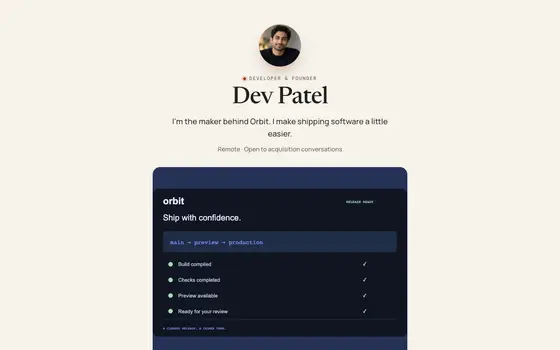 Paper
Editorial serif for writers and advisors.
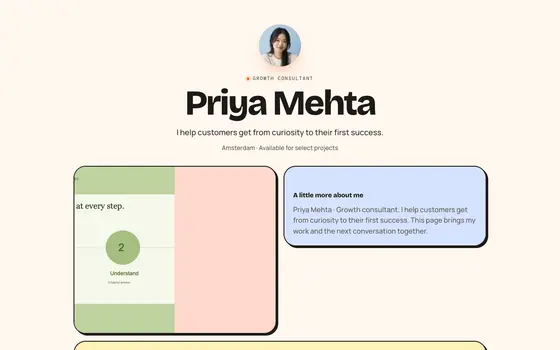 Bento Candy
Playful bento: every tile its own pastel, chunky type, a little bounce.
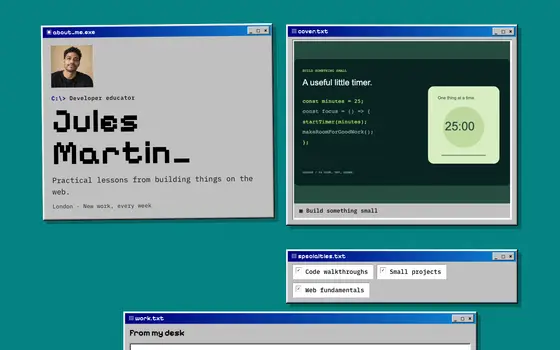 Retro OS
A 90s desktop: every section a bevelled window with a title bar, pixel type and a Start taskbar.
See all 36 templates, live pages in Explore, or describe your own and Ivo builds it.
Questions
Do students need a portfolio website?
It helps when you apply for internships, scholarships or research positions. A page shows projects and proof that don't fit on a one-page resume, and it's free on featurd.
What can I put on my portfolio with no work experience?
Course projects, hackathons, competitions, research, club roles, volunteering, part-time jobs and anything you've built or written on your own. Say what you did and what came of it.
Should I put my phone number on my page?
Use a contact form or email instead. It keeps your number off the open web; recruiters reply by email anyway.